How we work

Sprint-based delivery, lightweight governance.

Every engagement — direct or sub-contracted — runs through the same five phases. Short cycles, visible progress, no surprise scope.

01

Discovery

Current-state audit, stakeholder input, defined problem statement.

02

Design

Target architecture and solution design, agreed before build starts.

03

Build

Sprint-based configuration and development, with regular demos.

04

Launch

Testing, data migration and a phased cutover to production.

05

Hypercare

Close support through early live weeks, then handover or retained support.

Our process, end to end

Our CI/CD Integration Process

Our five delivery phases run on the same continuous‑integration / continuous‑delivery loop that modern software teams use — the eight stages below expand those phases into the full pipeline.

Hover or tap any stage for what it covers and how it maps to our phases.
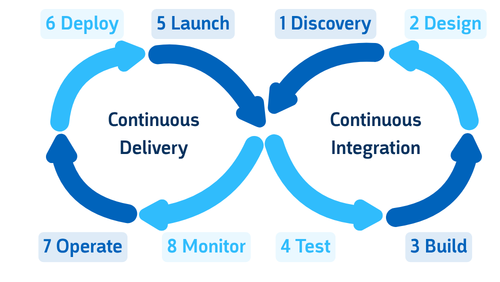
Digital Workers CI/CD integration loop with eight stages: Discovery, Design, Build, Test, Launch, Deploy, Operate and Monitor
6 · DeployDeploy. The approved release is promoted into production, ideally through automated, repeatable deployments that remove manual error.The production cutover inside our Launch phase — phased and actively monitored.
5 · LaunchRelease. A specific, versioned build is packaged and approved for production — release notes, sign‑offs and artefacts readied.Our Launch phase — a planned, phased cutover rather than a big‑bang switch.
1 · DiscoveryPlan. Requirements, features and roadmap are agreed with stakeholders, then scoped, prioritised and sequenced before any build starts.Our Discovery phase — current‑state audit, stakeholder input and a defined problem statement.
2 · DesignCode. The solution is architected and built against the plan — in a software pipeline, where developers write code and commit it to version control.Our Design phase — target architecture and solution design, signed off before build.
7 · OperateOperate. The live system is run and kept healthy — availability, capacity, incident response and routine change management.Our Hypercare phase — close support through the first live weeks, then handover or a retained managed service.
8 · MonitorMonitor. Real‑time visibility into performance, errors and business metrics — insight that feeds straight back into the next round of planning.Ongoing through Hypercare and any retained service — watching live sends, data flows and agent behaviour.
4 · TestTest. Automated unit, integration and end‑to‑end tests check the build against functional, performance and security standards before it can move on.Part of our Launch phase — functional testing and data‑migration validation ahead of cutover.
3 · BuildBuild. Every change is integrated into a shared repository and compiled into a single runnable, deployable artefact — continuous integration in the literal sense.Our Build phase — sprint‑based configuration and development, with regular demos.

Agile, not bureaucratic

Work runs in short sprints with regular demos and a visible backlog — enough structure to track progress, without the steering-committee overhead of a large SI programme.

Direct access to delivery

You deal with the people doing the work, not an account layer relaying it. Questions get answered same-day, not next sprint review.

Two ways to engage

Same delivery model, two different relationships.

Direct delivery

We work straight with your team, scoping and running the project against your goals — for mid-market companies who need Salesforce delivery without an enterprise SI's overhead or pricing.

Book a scoping call →

Sub-contracted delivery capacity

We plug into your delivery, white-labelled where required, as specialist Salesforce capacity behind your own client relationship — for SIs and agencies who need proven hands without hiring.

Discuss a partnership →

Want to see how this applies to your project?

A scoping call is the fastest way to find out.

Book a scoping call